Many radiologists still switch between separate PACS viewers and email threads to review a single case. The split workflow slows turnaround and raises the risk of missing prior studies. Medicai keeps all images, reports, and team notes inside one browser window, so nothing gets lost between locations.
By the end of this article you will know what zero-footprint viewing actually removes from your daily clicks, how AI triage slots into existing worklists, and whether the structured reporting tools match the templates you already use. You will also see the pricing tiers and the compliance documents that matter before you invite a second site to the platform.
What Is Medicai?
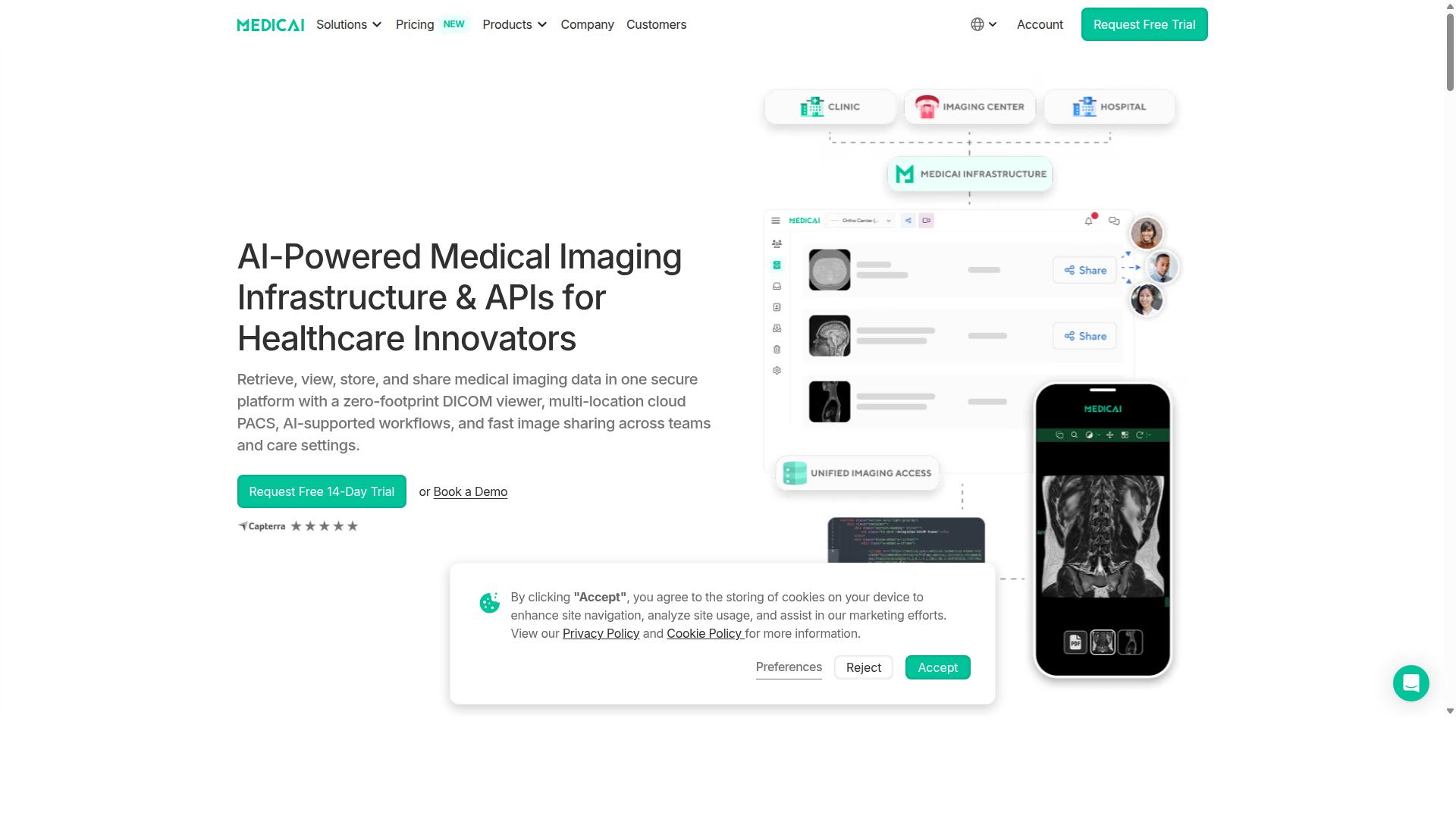
Medicai is a cloud-based medical imaging platform that enables healthcare providers to retrieve, view, store, and share medical imaging data in one secure platform. This unified system supports diagnostic viewing across different care settings, allowing medical professionals to access patient images from any location with internet access.
The platform features a zero-footprint DICOM viewer that requires no local installation. Healthcare providers can access this viewer through standard web browsers, eliminating the need for specialized software on individual workstations while maintaining full diagnostic capabilities.
Medicai operates through a multi-location cloud PACS model that connects facilities across geographic regions. This deployment approach supports Imaging Infrastructure as a Service (IIaaS), giving healthcare organizations access to enterprise-grade imaging capabilities without managing physical servers or infrastructure maintenance.
Why Medicai Is the Best for Diagnostic Viewing
Diagnostic accuracy improves when radiologists can access high-quality imaging quickly across any device without installing software.
The zero-footprint viewer eliminates delays from software downloads and IT approvals. Specialists open studies instantly on laptops, tablets, or phones, which speeds up consultations and reduces missed cases.
Secure cloud delivery keeps every image encrypted and accessible only to authorized users. Hospitals and clinics avoid local server maintenance, while patient data stays protected under HIPAA and GDPR standards.
During the past year, over 300k DICOM visualizations were completed through this system. Radiologists reviewed these studies without additional hardware or software, which shortened turnaround times for urgent cases.
Annual API transactions exceed 50 million, which enables consistent data exchange between hospital systems and external specialists. Referring physicians receive images without manual transfers, which limits errors and lost files.
Over 10,000 active doctors already work on the platform across 70 clinics and hospitals. This volume demonstrates reliable performance in real diagnostic environments where image quality and speed directly affect patient outcomes.
Key Features and What Makes Medicai Stand Out
Three built-in capabilities differentiate Medicai for everyday radiology practice.
Zero-footprint viewing eliminates local installations while maintaining full diagnostic quality. AI-supported workflows connect imaging data to automated analysis tools that speed up interpretation tasks. Structured reporting ensures consistent documentation and faster report generation across radiology teams.
These features work together within a cloud imaging platform that supports medical professionals at every stage of the diagnostic process. Medicai combines medical image viewer technology with radiology workflow tools that address common pain points in diagnostic viewing and image management.
Zero-Footprint DICOM Viewer
The zero-footprint DICOM viewer runs directly in any browser and displays full-resolution studies without local software installation.
Large studies load quickly on standard web browsers without requiring dedicated hardware or software updates. Multi-monitor setups receive support for side-by-side comparison of multiple series and studies during complex diagnostic viewing sessions.
Access remains available from any location with internet connectivity, enabling radiologists to review cases remotely without compromising image quality. HIPAA and GDPR compliance protect patient data during transmission and storage, while FDA and CEE clearance confirm the platform meets regulatory standards for medical imaging software.
Medical imaging solutions like this reduce setup time for new users and eliminate compatibility issues across different operating systems. The DICOM viewer supports immediate diagnostic viewing without the delays associated with traditional PACS installations.
AI-Supported Workflows
AI integration flags urgent findings and pre-populates measurements to shorten interpretation time.
Medicai connects to Rayscape.ai and other AI partners to automate triage, lesion detection, and quantitative analysis within the radiology workflow. These connections bring AI-powered diagnostics directly into the diagnostic viewing environment.
Chest CT workflows demonstrate the practical application where automated nodule sizing occurs during initial image loading. Radiologists receive pre-calculated measurements that support consistent diagnostic accuracy across multiple cases and readers.
The radiology AI co-pilot feature integrates with existing medical imaging platforms to enhance rather than replace human expertise. Medical professionals maintain control over final interpretations while benefiting from automated assistance on routine measurements and initial screening tasks.
Structured Reporting for Radiology
Templates and voice-to-text tools create standardized, machine-readable reports that connect with existing RIS or EHR systems.
Structured reporting reduces transcription errors by replacing free-text entry with predefined fields and terminology. This standardization speeds billing processes and enables quality audits that track diagnostic performance over time.
OHIF and MedDream viewer integrations support template reuse across different imaging modalities and clinical scenarios. Radiologists can apply consistent reporting formats while maintaining flexibility for case-specific findings and recommendations.
Medical records become more searchable and comparable when reports follow structured formats rather than narrative styles. This approach supports better communication between healthcare providers and improves the overall quality of radiology reporting within medical imaging systems.
Pricing and Plans
Medicai offers monthly subscription tiers scaled to storage and connectivity needs of imaging centers and hospitals. These options give healthcare providers the ability to select the right fit for their diagnostic viewing requirements without overpaying for unused capacity.
The Starter plan costs $249 per month and includes 500 GB cloud storage with unlimited user accounts. This tier works well for smaller practices or clinics that need reliable DICOM viewing without connected location requirements.
The Standard plan costs $749 per month and provides 2 TB cloud storage with unlimited user accounts plus one connected location. Larger radiology departments benefit from this level when they need to link their PACS system with external imaging sources.
Additional locations or storage capacity are available on demand for organizations that outgrow these base tiers. Enterprise customers receive custom pricing with multiple connected locations and external connections supported.
Yearly billing provides 15 percent savings on both Starter and Standard plans. The DICOM gateway setup carries a one-time $1,000 fee per location when required for system integration.
A free 14-day trial of Starter plan features is available without requiring a credit card. Per-study pricing options exist for enterprise customers who prefer this billing model instead of monthly subscriptions.
Trust Signals
Compliance, scale, and independent validation separate enterprise imaging platforms from consumer tools. Medicai demonstrates all three through documented volume, regulatory clearances, and infrastructure partnerships that healthcare providers evaluate during procurement.
The platform processes 1M+ studies each year and maintains 1.7M+ studies in storage. These numbers reflect adoption by 70 clinics and hospitals and daily use by 10,000+ active doctors who rely on the system for diagnostic viewing across multiple specialties.
Security and regulatory requirements receive equal attention. Medicai follows HIPAA and GDPR standards while maintaining FDA and CEE clearance for its viewers. The software also adheres to OWASP security guidelines, an explicit commitment that procurement teams can verify during technical assessments.
Enterprise infrastructure support strengthens these credentials. Partnerships with Microsoft Azure and Amazon AWS provide the hosting backbone required for medical imaging workloads at national and international scale. Health systems already operating within these cloud environments can connect without additional vendor relationships.
Volume metrics further confirm operational maturity. The platform has handled 2M+ imaging studies uploaded and delivered 300k+ visualizations of DICOM studies in the past year alone. 50M+ yearly API transactions indicate that external systems routinely exchange data with the platform, a practical measure of interoperability.
Who Should Use Medicai
Hospitals, outpatient imaging centers, and specialty groups that need fast image access across multiple sites benefit most. Medicai serves these organizations by connecting providers who require reliable diagnostic viewing tools.
Specialty practices in orthopedics, neurology, and oncology rely on consistent image quality for treatment planning. The platform supports these clinical needs through its cloud-based infrastructure.
Radiology departments and cardiology practices use the system for routine diagnostic workflows. Ophthalmologists and ob-gyn specialists access patient studies without location constraints.
Pulmonology clinics and dental practices benefit from the same unrestricted access. Gastroenterology teams review imaging data from any connected location.
Virtual care providers and telemedicine platforms integrate the software into their existing systems. Teleradiology services use it to deliver remote reading capabilities.
Personal injury lawyers access medical images for case preparation. Tumor boards and clinical trials coordinate reviews across participating institutions.
Medical education organizations utilize the platform for teaching purposes. Patients access their own studies through the dedicated patient portal.
Global online availability means healthcare providers in any region can connect to the same imaging platform. No geographic restrictions limit participation in diagnostic workflows.
Final Verdict
For practices seeking a secure, globally accessible cloud imaging platform, Medicai delivers measurable workflow gains and enterprise-grade compliance.
The platform combines cloud imaging infrastructure with diagnostic viewing tools that support multiple specialties. Healthcare providers gain consistent access to medical imaging from any location without local hardware requirements.
Compliance standards remain central to the architecture. Data handling follows established security protocols that protect medical records and support regulatory requirements across different regions.
Implementation focuses on practical integration with existing systems. The imaging platform connects with various medical imaging software environments while maintaining image quality standards required for accurate diagnosis.
Medical professionals who need reliable diagnostic tools can evaluate the platform through a live demonstration. Contact [email protected], US phone +1 (832) 220 1035, or Romania phone +40 316 305 875 to schedule a session and review specific workflow requirements.
Recommended Resources: