Many radiology teams still chase scattered images across hospital servers and email threads hours after a scan is complete. These delays slow diagnosis and force clinicians to decide patient care with incomplete data. Medicai removes that friction by keeping every study in one cloud workspace.
By the end of this article you will know exactly how the platform's AI workflows, zero-footprint viewer, and secure image exchange cut those delays and meet compliance rules. You will also see which care settings benefit most and what the pricing options cover.
What Is Medicai?
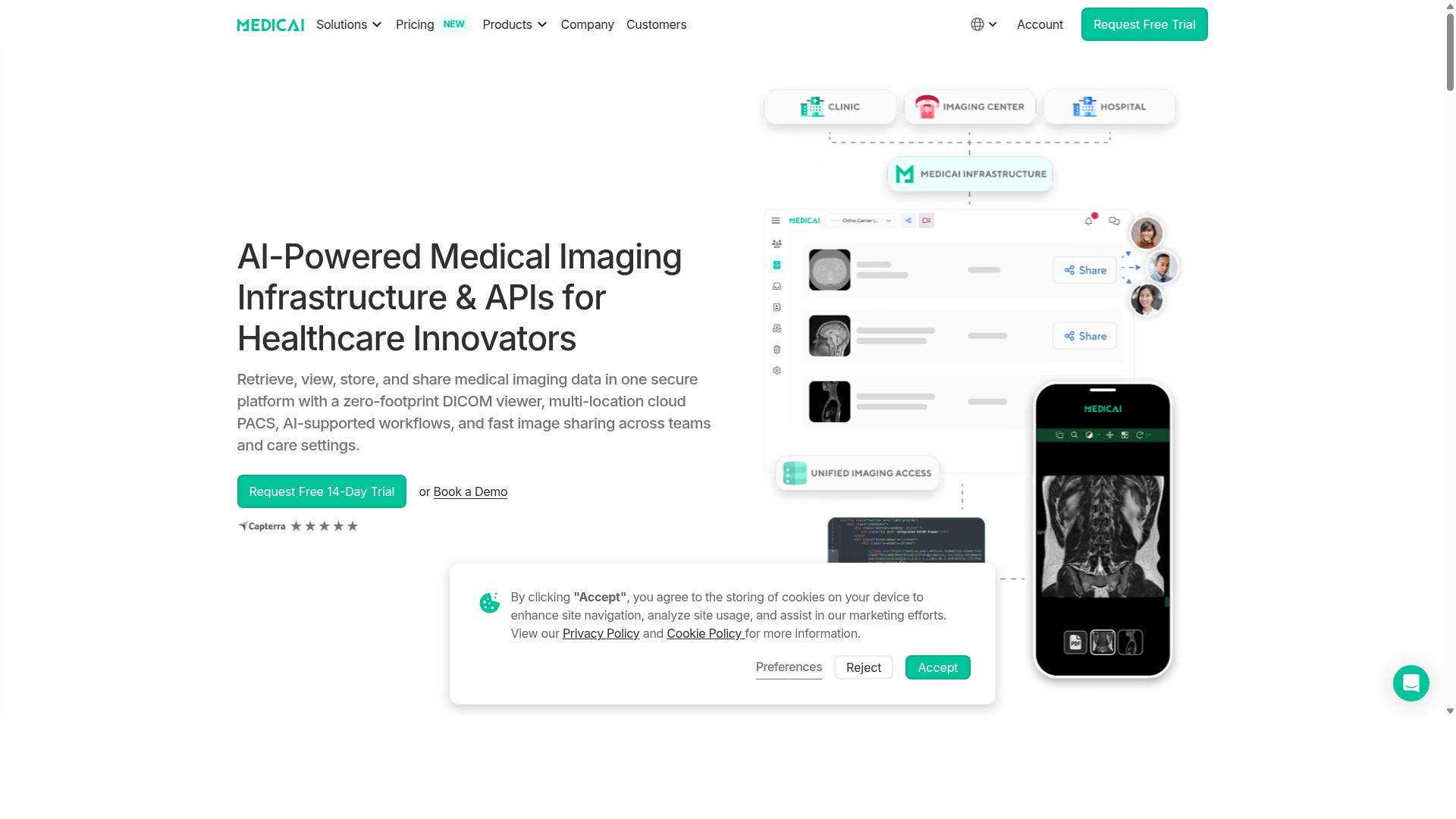
Medicai is a cloud-based medical imaging platform that enables healthcare providers to retrieve, view, store, and share medical imaging data in one secure environment.
The platform operates through a zero-footprint DICOM viewer that requires no local installation or hardware setup. This approach eliminates traditional barriers that slow down imaging access across multiple departments.
Healthcare facilities can consolidate their entire imaging workflow on a single system. Hospitals and imaging centers benefit from centralized storage that replaces fragmented on-premise solutions.
Medicai provides Imaging Infrastructure as a Service (IIaaS) that supports multi-location operations. This structure allows radiology teams to access studies from different sites through one unified interface.
The platform includes AI-supported workflows that enhance diagnostic processes while maintaining standard security protocols. Fast image sharing capabilities enable care teams to collaborate across various clinical settings without delays.
Medical imaging departments gain interoperability features that connect different systems and locations. The cloud PACS structure supports seamless data exchange between radiology teams and referring physicians.
Why Medicai Excels at AI Diagnostics
Medicai integrates AI tools directly into imaging workflows to improve diagnostic accuracy and reduce time-to-insight for radiologists. The platform supports multiple machine learning approaches that work together to enhance medical imaging analysis.
Deep learning and neural networks form the foundation of these diagnostic capabilities. These systems process CT scans, MRI images, and X-ray studies to identify patterns that may escape human observation during initial review.
Computer vision techniques enable precise image segmentation and lesion detection across various imaging modalities. The technology examines ultrasound and pathology slides to flag potential anomalies for further evaluation by clinical teams.
These AI capabilities augment radiologist decisions rather than replace professional judgment. The system highlights areas of concern while providing confidence scores that help physicians prioritize cases requiring immediate attention.
Research suggests that AI-assisted workflows can reduce false positives and false negatives in diagnostic imaging. This improvement stems from the consistent application of learned patterns across large datasets that would be impractical for manual analysis.
Turnaround time decreases when AI tools handle initial screening tasks. Radiologists can focus their expertise on complex cases while routine findings receive faster preliminary assessment through automated analysis.
Patient outcomes benefit from earlier detection of conditions such as tumors in oncology cases. The combination of human expertise and machine learning creates a more thorough review process that catches subtle changes in follow-up studies.
Workflow efficiency improves when these tools connect with existing PACS systems and support DICOM standards. The seamless connection allows radiologists to access AI insights without disrupting established clinical routines.
Key Features and What Makes Medicai Stand Out
Three core capabilities differentiate Medicai from legacy imaging systems.
These capabilities work together to create a unified platform that connects imaging data across departments and locations.
Medical imaging workflows benefit when automation, visualization, and exchange functions operate under one system.
Radiologists gain faster access to studies, AI insights appear within familiar reading environments, and external partners receive images without delay.
The following sections examine each capability and show how they support AI diagnostics in daily practice.
AI-Supported Workflows
AI-Supported Workflows embed automated lesion detection, tumor classification and anomaly detection directly into the clinical reading list.
Radiology AI Co-Pilot and AI-Powered Diagnostics run in the background and surface findings within existing worklists.
Supported modalities include CT, MRI, X-ray, and ultrasound.
Results reach the radiologist in the order studies arrive, eliminating separate login steps or external portals.
Structured Reporting for Radiology templates appear alongside AI outputs, allowing findings to transfer into reports with minimal retyping.
Integration with the Doctor Imaging Portal keeps every annotation and measurement inside the same interface.
Because the system routes cases automatically, staff spend less time sorting studies and more time reviewing critical images.
Zero-Footprint DICOM Viewer
The zero-footprint DICOM viewer renders studies instantly in any browser without local installation while supporting advanced image segmentation annotations.
Users open cases on hospital workstations, home computers, or tablets without additional software.
Real-time collaboration tools allow multiple clinicians to view the same study simultaneously and add annotations that appear for all participants.
The viewer connects to existing systems through HL7 and FHIR standards, pulling patient context from the EHR when a study loads.
Mobile Imaging App extends the same functionality to smartphones, maintaining image quality and annotation options on smaller screens.
Because no data remains on local devices after the session ends, hospitals maintain tighter control over protected health information.
Cloud PACS and Image Exchange
Cloud PACS and Image Exchange provide vendor-neutral archiving, automated routing, and instant study sharing across connected locations.
The Medical Imaging Uploader accepts studies from any modality or referring facility and stores them in the Vendor Neutral Archive.
DICOM Gateway handles inbound and outbound traffic, translating formats when necessary.
Medical Image Exchange moves studies between departments or external partners without physical media.
Backup and Disaster Recovery services keep copies in geographically separate locations, supporting continuous access during outages.
Patient Case Management organizes studies, reports, and AI results into single records that clinicians can reference during tumor boards or follow-up visits.
These services operate under one subscription, removing the need to maintain separate servers or negotiate multiple vendor contracts.
Pricing and Plans
Medicai offers tiered monthly subscriptions scaled to storage and connected-location needs. The Starter plan starts at $249 per month and includes 500 GB of cloud storage with unlimited user accounts, though it supports no connected locations. This entry-level option suits smaller practices or teams testing AI diagnostics capabilities.
The Standard plan starts at $749 per month and expands storage to 2 TB while adding one connected location. Unlimited user accounts remain included, making this tier suitable for growing radiology departments that need basic DICOM integration.
Enterprise customers can access custom pricing that accommodates multiple connected locations and external sites. Per-study pricing options exist for organizations that prefer usage-based billing rather than fixed monthly fees.
Yearly billing provides 15 percent savings across available tiers. The Starter plan drops to $209 per month when paid annually, while the Standard plan becomes $639 per month. A 14-day trial of Starter plan features is available without requiring a credit card.
DICOM Gateway setup costs $1,000 as a one-time fee per location. Refunds are not available for partial billing periods, so organizations should evaluate their storage and connectivity requirements before selecting a plan.
Trust Signals
Security credentials and measurable platform performance build buyer confidence.
Medical facilities need reassurance when adopting AI diagnostics solutions. Trust signals demonstrate that the platform meets strict security standards while handling large volumes of sensitive imaging data. Buyers evaluate these requirements before committing to new technology.
Compliance certifications and performance metrics together create a reliable foundation. These elements show that Medicai maintains regulatory standards and processes substantial volumes of medical imaging studies daily. Organizations can assess both aspects when making platform decisions.
Compliance and Security
Compliance and Security certifications include HIPAA, GDPR, and FDA/CEE clearance for the viewer.
Medical imaging platforms must satisfy multiple regulatory frameworks before deployment. HIPAA and GDPR compliance ensures patient data protection across different jurisdictions. These standards address data privacy requirements that vary by region.
FDA/CEE clearance confirms that the viewer meets medical device standards for diagnostic use. OWASP security guidelines provide additional protection against common web application vulnerabilities. The combination of these certifications addresses both regulatory and technical security needs.
Healthcare organizations require these specific credentials before integrating new diagnostic tools. Each certification addresses different aspects of patient data handling and system security. Medical facilities can verify these credentials through official regulatory databases.
Proven Scale and Performance
Proven Scale and Performance numbers show more than 1 M studies processed yearly and 50 M API transactions annually.
Volume metrics indicate platform reliability under real-world conditions. 1 M+ studies transacted or processed per year demonstrates consistent handling of diagnostic imaging workloads. This throughput level shows operational readiness for busy medical facilities.
1.7 M+ studies in storage and 300 k+ visualizations of DICOM studies in the last year reflect sustained usage patterns. 50 M+ yearly API transactions indicate strong integration capabilities with existing hospital systems. These figures come from actual platform activity rather than projected estimates.
Medical facilities processing high imaging volumes need platforms that maintain performance at scale. The documented transaction volumes show that Medicai handles both routine and peak diagnostic workloads effectively. Performance at these levels supports daily radiology operations without interruption.
Who Should Use Medicai
Medicai is designed for any healthcare provider that generates or consumes medical imaging studies. The platform supports a wide range of clinical environments where AI diagnostics and medical imaging intersect.
Several medical specialties benefit from this approach. Orthopedics, neurology, oncology, radiology, cardiology, and ophthalmology teams rely on imaging for accurate diagnosis and treatment planning.
Additional specialties also use the system regularly. Ob-gyn, pulmonology, dentistry, and gastroenterology providers turn to Medicai for streamlined access to medical imaging data and AI-driven insights.
Beyond clinical teams, Medicai serves hospitals, imaging centers, and specialty care providers. Virtual care providers and telemedicine platforms integrate the solution to enhance remote diagnostic capabilities.
Teleradiology services use the platform to deliver faster, accurate reads across locations. Personal injury lawyers and tumor boards also benefit from organized imaging data and collaborative review tools.
Clinical trials and medical education organizations access Medicai for structured imaging review and documentation. Patients can connect through the Patient Portal for secure access to their studies.
Final Verdict
For imaging teams seeking AI-ready workflows, zero-footprint access, and globally available cloud storage, Medicai offers a compelling platform.
Medical imaging departments need reliable tools that support AI diagnostics without extensive infrastructure changes. Medicai provides a cloud platform that meets these requirements while maintaining compliance standards for healthcare data.
The platform addresses key operational needs through its zero-footprint design and global cloud storage capabilities. These features allow imaging teams to access diagnostic tools from any location without additional hardware investments.
Contact details for demo scheduling and sales inquiries are listed below for teams interested in exploring these capabilities.
Medicai USA
7901 4th St N, STE 300
St. Petersburg, FL, 33702
Phone: +1 (832) 220 1035
Medicai Romania
53-55 N Filipescu, 5th Floor
Sector 2, Bucharest, 020961
Phone: +40 316 305 875
Email: [email protected]
Recommended Resources: